If you take osteoporosis medication such as Fosamax or Prolia, you may wonder whether dental implants are still an option.
These medications affect bone remodeling, which plays an important role in how your jawbone heals after implant surgery.
Getting dental implants while taking osteoporosis medication is possible for many patients, but your dentist needs to assess your medication type, dosage, treatment history, and individual risk factors before recommending surgery.
Blood thinners such as Eliquis or warfarin require separate planning because they affect bleeding rather than bone remodeling.
Your dental team can coordinate with your prescribing doctor to determine an appropriate treatment plan without unnecessarily interrupting your medication.
Key Takeaways
- Jaw-healing risk and bleeding risk are separate questions with separate answers.
- Osteoporosis-dose bone drugs carry much lower jaw risk than cancer-dose therapy.
- Most blood thinners keep going during routine implant surgery, with bleeding controlled at the site.
How Do These Medications Change Implant Risks?
Bone drugs and blood thinners change your implant plan in two different ways. Bone drugs can slow how your jaw repairs itself after surgery.
Blood thinners make bleeding harder to stop during and right after the procedure. Your dentist checks each risk with its own set of questions, and neither one is a reason to change your pills without your doctor.
Why Bone Healing and Bleeding Need Different Assessments
Your bones are always being rebuilt. Some cells clear away old bone while others lay down new bone. Doctors call this bone turnover.
Antiresorptive medication slows the cells that break bone down. That helps prevent fractures.
It also means your jaw may repair itself more slowly after surgery, which is why antiresorptive therapy shapes how your dentist thinks about bone healing and implant failure risk.
Blood thinners work on a different system. Anticoagulants (like warfarin or Eliquis) slow the clotting process in your blood.
Antiplatelet medications (like aspirin or clopidogrel) keep tiny blood cells called platelets from clumping together.
Unlike osteoporosis medications, the primary concern with anticoagulants and antiplatelet medications during implant surgery is bleeding management rather than changes in bone remodeling.
| Question | Bone drugs | Blood thinners |
| Main concern | Slow jaw healing, rare bone exposure | Bleeding during and after surgery |
| When it shows up | Weeks to months later | Hours to days |
| Key details | Drug, dose, schedule, years of use | Drug, reason taken, kidney function, surgery size |
| Who coordinates | Your bone or cancer doctor | Your cardiologist or primary doctor |
Why You Should Not Stop Medication on Your Own
Stopping a blood thinner can lead to a stroke, heart attack, or a clot in your lungs. Those events are far more serious than oozing from a gum wound, which your dental team can see and treat.
Bone drugs carry their own stopping risks. Prolia (denosumab) is the clearest example. If you skip or delay a dose, bone loss can speed up quickly, and some people get spine fractures.
So if a dental office tells you to “just skip your shot,” call your prescriber first.
What Changes When You Take Both Types of Medication?
Taking both doesn’t double one risk. It means your team plans for two separate issues at once.
You’ll want to plan for:
- Bleeding control on surgery day
- Gentle handling of the bone to protect healing
- Smaller surgeries done in stages when you need a lot of work
- Talks with more than one prescriber
Many people on both drug types get implants without trouble. The plan just has a few more steps.
What Do Osteoporosis Medications Mean for Jaw Healing?
For most people taking a bone drug at osteoporosis doses, the risk of a serious jaw problem after implant surgery is low.
That risk climbs sharply with cancer-dose treatment. Your dentist needs the exact drug name, how it’s given, how often, and how many years you’ve used it.
How Do Fosamax, Actonel, Boniva, Reclast, and Prolia Differ?
These drugs fall into two main families.
Bisphosphonates stick to bone and stay there for years. Oral bisphosphonates include alendronate (Fosamax), risedronate (Actonel), and ibandronate (Boniva), taken as weekly or monthly pills.
Intravenous bisphosphonates include zoledronic acid (Reclast), given as a yearly infusion for osteoporosis.
Denosumab (Prolia) is a shot that works differently. It doesn’t build up in bone, so its effect fades within months.
For osteoporosis, Prolia is a 60 mg injection every 6 months, while the cancer version (Xgeva) is 120 mg every 4 weeks.
Other drugs fit in, too:
- Romosozumab (Evenity) builds bone and slows breakdown. It’s given monthly for up to 12 doses and is linked to jaw risk.
- Teriparatide (Forteo) builds bone and is not tied to the same jaw risk as bisphosphonates or denosumab.
| Drug | How it’s given | Lingers in bone? |
| Fosamax, Actonel, Boniva | Pill | Yes, for years |
| Reclast | Yearly IV | Yes, for years |
| Prolia | Shot every 6 months | No, fades in months |
| Forteo | Daily shot | No |
What Is MRONJ, and How Does Treatment Dose Affect Risk?
Medication-related osteonecrosis of the jaw (MRONJ) is a rare problem where part of the jawbone doesn’t heal. Bone may show through the gums, and the area can stay sore or get infected.
You may also hear it called osteonecrosis of the jaw (ONJ).
Your MRONJ risk depends a lot on why you take the drug. Cancer patients get much higher, more frequent doses, and their risk is much greater. Osteoporosis patients on standard doses face a far smaller risk.
Implants still deserve care. A 2025 systematic review and international taskforce consensus statement found no evidence that antiresorptive treatment increases implant failure in patients with osteoporosis, although the available evidence remains limited.
Long-term bisphosphonate use may be associated with a small increase in MRONJ risk. Your dentist should consider medication history, gum health, and other medical conditions before recommending implant surgery.
Does a Drug Holiday Reduce Implant Complications?
A drug holiday is a planned break from a bisphosphonate. Experts don’t agree on whether a break before implant surgery lowers jaw risk, because these drugs stay in bone for years after the last dose.
According to the American Dental Association, there is insufficient evidence to recommend routinely stopping osteoporosis-related antiresorptive medication before dental treatment to prevent MRONJ.
Any medication adjustment should be coordinated with the prescribing doctor based on your fracture risk and individual treatment needs.
Prolia is different. A break isn’t a safe move unless your doctor plans what comes next. Your dentist will more likely time surgery within your dosing cycle, so ask before booking.
How Are Blood Thinners Managed Around Implant Surgery?
Many patients can continue their prescribed blood thinners during routine dental implant procedures.
However, the extent of surgery, medication type, kidney function, and individual bleeding risk determine whether additional precautions or prescriber-directed adjustments are needed.

What Matters About Warfarin, Eliquis, Xarelto, Aspirin, and Clopidogrel?
Each drug behaves a little differently:
- Warfarin: Its strength changes with diet, illness, and other medicines, so it’s checked with a blood test.
- Apixaban (Eliquis) and rivaroxaban (Xarelto): These medications have shorter-lasting anticoagulant effects than warfarin. Kidney function, dosing schedules, and the extent of surgery help determine whether any medication timing adjustments are needed.
- Aspirin: Often continued for minor oral surgery.
- Clopidogrel: Very important after a heart stent. Stopping too early can cause a dangerous clot.
The reason you take the drug shapes the plan as much as the drug itself. A mechanical heart valve or a recent stent means stopping is riskier.
Dentists have long debated the balance between bleeding and clot risk for anticoagulants in implant care, and current practice leans toward keeping you on your medication.
When Are INR Testing or Prescriber Instructions Needed?
If you take warfarin, expect an INR test close to your surgery date. INR, or international normalized ratio, measures how long your blood takes to clot compared with a standardized reference.
Your dentist uses this result to help assess bleeding risk before surgery.
You’ll need written prescriber instructions when:
- You take two blood thinners together
- You have a stent, valve, or recent clot
- Your kidney function is reduced
- You need several implants, bone grafts, or a full-arch procedure
For Eliquis or Xarelto, your doctor may adjust when you take a dose around a bigger surgery. Never guess at the timing yourself.
How Do Dentists Control Bleeding During and After Surgery?
Bleeding control starts before the first incision. Your team plans small, gentle openings in the gums and gets gum inflammation under control first.
During and after implant surgery, your team may use:
- Firm gauze pressure
- Sutures to close the gums snugly
- Local hemostatic measures, like collagen or gelatin sponges placed in the site
- Tranexamic acid, a rinse or soaked gauze that helps clots hold
Splitting large cases into stages also helps, since your team can watch how one site heals before treating the next. Pain relievers like ibuprofen can add bleeding risk, so ask which one fits your medicine list.
What Should Your Castro Valley Implant Team Review Before Surgery?
Your implant team should review your full medication details, your imaging, and your gum health before choosing a plan.
If you’re still sorting out whether you’re a fit at all, our post on evaluating implant candidacy covers the basics. The details below are where medication users need extra attention.
Which Medication Records and Medical Details Should You Bring?
Bring the real bottles or a printed portal list. Memory gets fuzzy on start dates.
Your list should include:
- Every bone drug, with the start date and last dose date
- Your next Prolia or Reclast date
- Each blood thinner, its dose, and the reason you take it
- Recent INR or kidney lab results
- Steroids, diabetes medicines, and supplements like fish oil
- Your prescribers’ names and phone numbers
What Can DXA Results and a CBCT Scan Tell Your Dentist?
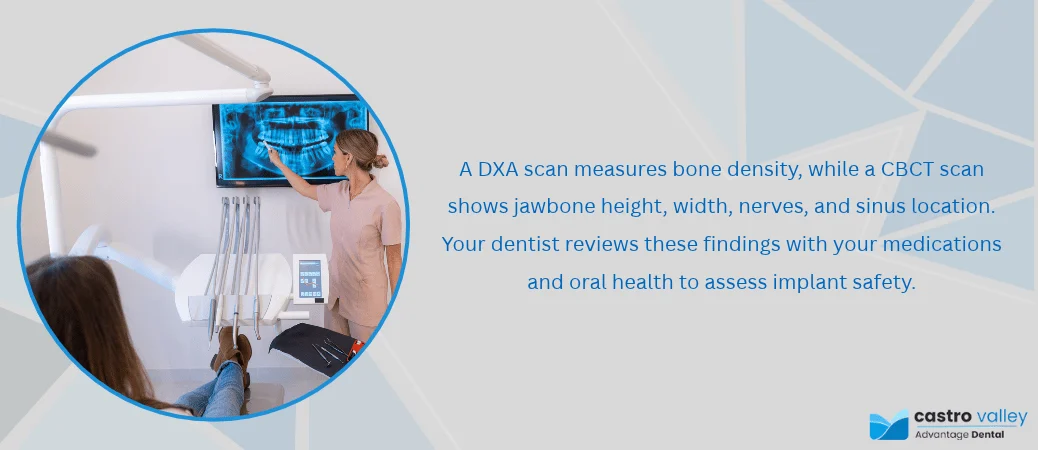
A DXA scan (also written DEXA scan) measures bone mineral density at your hip and spine. Your T-score shows whether you have osteopenia or osteoporosis. It doesn’t tell your dentist how much bone sits at your implant site.
A cone beam CT scan (CBCT scan) shows your jawbone in 3D, including bone height, width, nearby nerves, and the sinus. This type of dental imaging technology helps your dentist determine where an implant can be placed safely.
No single scan or bone blood test predicts implant safety. Your dentist reads them together with your medicines and your mouth.
How Do Gum Disease, Bone Grafting, and Sinus Lifts Affect Planning?
Active gum disease raises infection risk and should be treated first. Periodontal therapy can help control gum inflammation and create a healthier foundation for implant treatment.
Bone grafting and sinus lifts add more surgery. That means bigger wounds, more bleeding on blood thinners, and more bone that needs to heal on bone drugs.
Your team may stage these steps, choose a shorter implant, or suggest a plan that skips grafting entirely.
What Determines Healing Time and Whether Immediate Loading Is Appropriate?
Osseointegration is how your jawbone grows onto the implant. For many people, that takes about three to six months.
Immediate loading means getting a tooth on the same day. It depends on strong implant stability when the implant goes in.
Soft bone, grafting, or a bone-drug history may point toward a slower, staged approach. You can still get a temporary tooth, so you don’t have to go without teeth while healing.
Antibiotics are decided case by case. Don’t expect a standard prescription for everyone, and do mention any heart valve or joint replacement.
How Can You Protect Healing and Recognize Complications?
Gentle daily care and quick calls about warning signs protect your implant the most. Most healing goes smoothly, and catching small problems early keeps them small.
What Daily Care Supports Healing and Long-Term Implant Health?
For the first days, follow your aftercare sheet closely. Many of the same dos and don’ts after a tooth extraction apply here: no straws, no smoking, and no hard spitting.
Over the long run, good oral hygiene helps prevent peri-implantitis (gum infection around an implant) and marginal bone loss.
Soft brushes, floss made for implants, and water flossers all help, and our list of oral hygiene products for implants names specific options.
Regular preventive dental care also allows your dentist to monitor gum health, implant stability, and changes in the surrounding tissues.
Which Bleeding or Jaw Symptoms Need Prompt Attention?
Some mild oozing on the first day can be normal. Contact your dental team promptly if bleeding continues despite 30 minutes of firm gauze pressure or if swelling and pain become progressively worse.
Seek emergency medical care immediately if you experience difficulty breathing or swallowing, rapidly increasing swelling, severe uncontrolled bleeding, or fainting.
Weeks later, watch for exposed bone, a rough spot on the gums, pus, numbness, or pain that keeps getting worse. These can be early MRONJ signs if you take a bone drug, so tell your team about them quickly.
What Tooth Replacement Options Are Available if Surgery Is Deferred?
Sometimes waiting is wiser, such as during active cancer-dose treatment or while your doctor adjusts a medicine.
You still have choices:
- Partial dentures: Removable appliances that replace missing teeth without implant surgery.
- Dental bridges: Fixed restorations supported by neighboring teeth.
- Implant-supported bridges: An option to reconsider later if your medical condition and jaw health allow implant placement.
Plan Your Implant Treatment Without Changing Prescriptions Yourself

Your safest path toward dental implants starts with a thorough medication review and coordination with your prescribing doctor.
Taking osteoporosis medication or a blood thinner does not automatically rule out implant treatment, but your plan should reflect your individual health needs.
Before your consultation, gather your medication list, recent laboratory results, and upcoming osteoporosis treatment dates.
Continue taking your medications as prescribed unless your prescribing doctor recommends a change.
At Castro Valley Advantage Dental, implant planning takes your medication history, jawbone condition, and overall oral health into account.
Dr. Matthew Yuen can evaluate your implant candidacy, discuss potential healing risks, and help you understand which treatment approach may be appropriate for your needs.
Frequently Asked Questions
Can I get dental implants if I have taken Fosamax for years?
Yes, many people who have taken Fosamax for years still get implants. Long-term use can raise MRONJ risk a little, so your dentist may use gentler techniques, avoid extra grafting, and coordinate with your doctor.
Don’t stop the pill on your own.
Does a yearly Reclast infusion rule out dental implants?
No, a yearly Reclast infusion for osteoporosis doesn’t automatically rule out implants. It’s a much lower dose than the zoledronic acid given for cancer. Your team will want your infusion dates and how many years you’ve had it.
Should dental implant surgery be timed around my Prolia injection?
Often, yes. Many dentists schedule surgery partway through your six-month cycle, as your prescriber advises. Never delay a Prolia shot without your doctor’s plan, because missed doses can cause rapid bone loss and fractures.
Will I need to stop Eliquis or warfarin before an implant?
Usually not for a routine implant. Warfarin patients need an INR in their target range, and Eliquis timing may shift for larger surgery based on kidney function. Only your prescriber should change your doses.
What if I take both osteoporosis medication and a blood thinner?
You can still be a candidate. Your team plans for bleeding control and bone healing together, often staging larger work. Expect your dentist to talk with both prescribers.
What should I do if bleeding continues after implant surgery?
Bite firmly on folded gauze or a damp black tea bag for 30 minutes without peeking. If postoperative bleeding stays bright red or keeps going, call your dental office right away. Go to the ER for fast swelling or trouble breathing.