
Is one tooth darker than the others, even though you brush and care for your teeth regularly? A single dark or gray tooth can develop after an old injury, root canal treatment, or changes within the tooth itself.
Your dentist first needs to determine why the tooth has darkened before recommending treatment. Internal bleaching may help lighten a healthy, root-treated tooth, while a veneer or crown may be more appropriate when discoloration persists or the tooth needs structural protection.
A dark tooth does not always mean that a root canal has failed or that the tooth needs extraction.
A thorough dental assessment can help identify the cause, while appropriate cosmetic dentistry options can help the tooth blend more naturally with the rest of your smile.
Why Is One Tooth Darker Than the Others?
Your front tooth can darken when pigments build up inside it after dental trauma or dental treatment. The shade gives your dentist a clue, but you need an exam to identify the cause.
How an Old Injury Can Cause Delayed Internal Staining
After a tooth injury, bleeding inside your tooth can leave pigments in dentin, the layer beneath your enamel. Because enamel lets light pass through, those internal stains show through the surface.
Damage to your tooth’s blood supply can also lead to pulp necrosis, meaning the soft tissue inside dies.
You might hear this called a “dead tooth” or “non-vital tooth.” These changes can develop without noticeable symptoms, so the absence of pain does not necessarily mean the pulp is healthy.
Why a Previously Root-Treated Tooth Can Look Gray
Your root-treated tooth can darken from old blood pigments, tissue left in the pulp chamber, or staining from dental materials. A leaking filling or new decay also needs consideration.
Some pulp-treatment materials carry a risk of tooth discoloration. If your treatment involved an MTA bioceramic material, your dentist will consider the specific product and its location when assessing the stain.
Does a Gray Tooth Always Mean the Pulp Has Died?
Your tooth’s gray appearance alone does not establish pulp death. After trauma, you can have temporary discoloration or changes in the pulp that require follow-up before a diagnosis becomes clear.
Your dentist looks for several findings together before recommending treatment. The need for treatment of damaged tooth pulp depends on your examination and test results, not the shade of your tooth alone.
What Else Can Cause One Tooth to Look Darker?
An old injury or root canal is not the only reason one tooth may look darker than its neighbors.
Tooth decay, staining around an existing filling, or changes in the natural shade of the enamel and dentin can also create a noticeable difference.
Your dentist can determine whether the discoloration is limited to the surface or originates deeper within the tooth.
That distinction helps identify whether professional cleaning, whitening, restorative treatment, or another approach is appropriate.
What Must Be Checked Before Fixing the Color?
Before cosmetic treatment, you need a dental assessment of your tooth’s pulp, root, surrounding bone, and remaining structure.
Your dentist also checks existing restorations and whether your bite puts extra stress on the tooth.
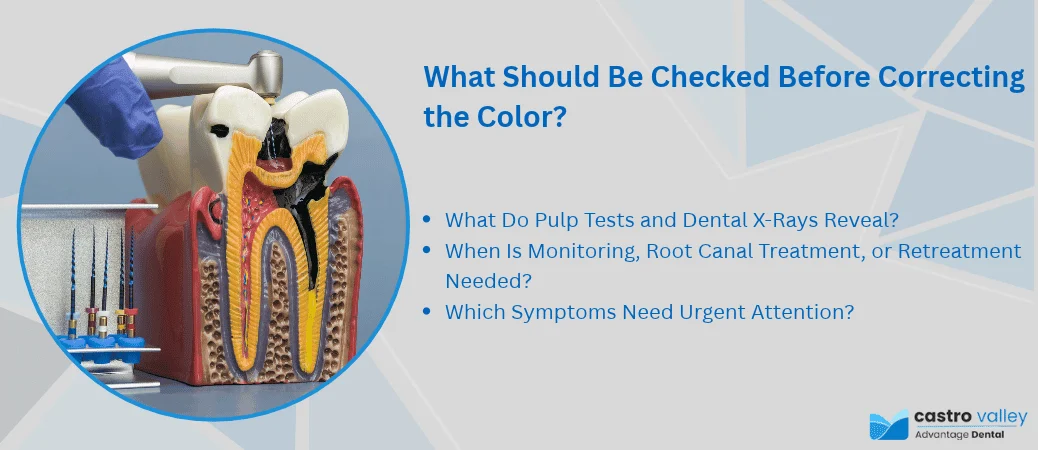
What Do Pulp Tests and Dental X-Rays Reveal?
For a tooth that has not undergone root canal treatment, your dentist may use a cold test or electric pulp testing to assess whether the nerves inside the tooth respond.
These tests measure nerve responses rather than blood flow directly.
After recent trauma, your nerve response can be temporarily absent even when the pulp survives.
Your dentist compares results with nearby teeth and interprets them alongside your history, exam, and imaging; repeat testing might be needed.
Periapical X-rays show the root and surrounding bone. If a suspected fracture, internal resorption (loss of tooth tissue from within), or another problem remains unclear, additional dental imaging technology, such as cone-beam CT, may help your dentist or endodontist assess the tooth more closely. Not every gray tooth requires this type of scan.
When Is Monitoring, Root Canal Treatment, or Retreatment Needed?
You may need monitoring when the findings remain uncertain and your tooth shows no clear infection or other disease. Follow-up visits let your dentist compare symptoms, test responses, and X-rays over time.
If your pulp has died or become infected, root canal treatment addresses the damaged tissue inside your tooth.
Root canal therapy does not reliably restore the original color, so you might still need a separate whitening or restorative step.
For an already treated tooth, persistent infection or a leaking restoration requires assessment before bleaching.
Your endodontist might recommend retreatment; an apicoectomy, surgery near the root tip, is reserved for selected cases with disease that needs that approach.
Which Symptoms Need Urgent Attention?
Increasing pain, swelling, discomfort when biting, or a gum bump that drains may indicate a problem requiring prompt assessment. These symptoms can be signs of dental emergencies rather than a cosmetic concern alone.
Seek emergency medical care if swelling spreads toward your eye or neck, or you have trouble breathing or swallowing. A color change without these symptoms still warrants a dental appointment, even when your tooth feels comfortable.
Can Internal Bleaching Match the Neighboring Teeth?
If your tooth has a satisfactory root canal filling, no signs of active infection, and enough remaining healthy structure, internal bleaching may offer a conservative way to lighten internal discoloration.
How the Walking Bleach Technique Works
With the walking bleach technique, your dentist accesses the pulp chamber through the back of your root-treated tooth.
After checking the root filling, your dentist places a protective barrier over it to limit bleaching-agent movement toward the root.
A bleaching material goes inside the chamber, and a temporary filling seals the opening between visits.
You return for checks and replacement of the material as needed; your dentist then removes it and seals the access with a permanent restoration after the appropriate waiting period.
You should never attempt internal bleaching yourself. Your dentist also should not remove healthy pulp solely to make this whitening method available.
How Dentists Select and Reassess the Target Shade
Your dentist records the color of your neighboring teeth with shade tabs and photographs, sometimes supported by a digital shade device.
Your tooth is assessed while hydrated because drying makes enamel look temporarily lighter.
Your match involves hue, brightness, and how much light passes through the tooth. Your dentist reassesses the shade after bleaching and allows it to settle before choosing the final filling color.
A small difference near your gumline or biting edge can remain even after substantial improvement. Your dentist should explain that possibility before treatment begins.
What Are the Limits, Risks, and Chances of Redarkening?
Your tooth might lighten unevenly, respond only partly, or darken again later. Material-related stains and very dark areas can be harder to correct, and existing fillings keep their original color.
Your dentist must also account for external cervical resorption, an uncommon but serious loss of tooth tissue near the gumline associated with internal bleaching.
A history of trauma, the bleaching method, and the protective seal affect the risk assessment.
Modern planning avoids heat-based bleaching and uses a protective barrier. You still need follow-up, as internal bleaching results vary between teeth, and a close match is not guaranteed.
Should You Whiten the Other Teeth First?
If you want a lighter smile throughout, discuss that goal before your dentist chooses the final shade for your front tooth.
Professional teeth whitening before matching a veneer or crown can provide a clearer target shade for your final restoration.
Your dentist will plan the timing of external and internal bleaching and let the color settle before matching a veneer, crown, or filling.
If you experience sensitivity during teeth whitening, your plan might need a lower-strength product or a pause.
When Is a Veneer or Crown the Better Match?
You might need a veneer when discoloration persists in an otherwise sound tooth, or a crown when substantial damage calls for greater coverage. Your remaining enamel and tooth structure guide that choice.

Masking a Single Discolored Tooth With a Porcelain Veneer
Your dentist checks how much healthy tooth structure remains above the gumline and how your teeth meet.
When coverage is appropriate, a custom dental crown can restore the tooth’s appearance while protecting its remaining structure.
Deep gray staining requires careful masking. Your dentist might suggest lightening the underlying tooth first to reduce how much opaque porcelain is needed.
Because preparation commonly removes enamel, you should treat porcelain veneers as a long-term commitment. You will need ongoing checks and eventual repair or replacement if the restoration wears or fails.
When a Crown Is Needed to Protect Weakened Tooth Structure
You might need a dental crown when your tooth has a large filling, major loss of structure, or a fracture that requires coverage. Having a root canal by itself does not automatically mean your front tooth needs a crown.
Your dentist checks how much sound tooth structure remains above the gumline and how your teeth meet. When coverage is appropriate, your dental crown is planned for both protection and appearance.
| Your treatment consideration | Internal bleaching | Porcelain veneer | Dental crown |
| Main purpose | Lighten internal stain | Mask visible discoloration | Cover damaged structure |
| Tooth coverage | No outer covering | Mainly front surface | Around the tooth |
| Tooth preparation | Internal access | Front-surface preparation | Greater tooth reduction |
| Existing root canal required | Yes | No | No |
How Underlying Darkness and Translucency Affect the Result
Your natural front teeth transmit and reflect light in different ways across their surfaces. A single restoration needs to reproduce that effect while hiding the darker tooth beneath it.
Your dentist and dental laboratory balance porcelain thickness, opacity, and the shade of the bonding material. Too much translucency lets darkness show through; too much opacity creates a flat-looking result.
For a natural-looking front crown, your dentist records the underlying tooth color as well as your neighboring shades. Reviewing the restoration before permanent placement gives you a chance to discuss a visible mismatch.
How to Maintain the Color Match Over Time
You help preserve your result by brushing with fluoride toothpaste, cleaning between your teeth, and attending dental checks.
If you grind or clench your teeth, custom oral appliances such as night guards may help protect your restoration from excessive biting forces.
Your natural teeth may change color with age and staining, while porcelain generally retains its original shade. Surface staining or wear can still affect the appearance of a restoration over time.
Your crown’s long-term care also includes checking its edges and the tooth beneath it. Report a loose restoration, new discomfort, or a change near the gumline.
Choose the Least Invasive Option That Keeps the Tooth Healthy

When one tooth is darker than the others, the first step is determining whether the discoloration is cosmetic or related to an underlying dental problem.
If your root-treated tooth is healthy and largely intact, internal bleaching may offer a conservative way to improve its appearance.
When bleaching does not achieve a suitable match, a porcelain veneer may help conceal persistent discoloration. A dental crown may be more appropriate when the remaining tooth structure needs additional protection.
At Castro Valley Advantage Dental, your treatment plan begins with understanding the cause of discoloration, the condition of your tooth, and your smile goals.
Dr. Matthew Yuen can assess your discolored tooth, explain which treatment options may be suitable, and help you understand what kind of shade improvement is achievable while preserving healthy tooth structure.
Frequently Asked Questions
Your gray tooth deserves a diagnosis before you choose a cosmetic treatment. These practical details help you prepare for that conversation.
Can a tooth turn gray decades after an injury?
Yes, you can notice gray discoloration decades after a tooth injury. Your dentist will assess whether the change reflects old staining, delayed pulp damage, or another problem such as decay.
Does a gray tooth after a root canal mean the treatment failed?
Your tooth’s gray color alone does not establish root canal failure. Your dentist checks symptoms, the restoration’s seal, and X-rays for evidence of disease before recommending retreatment.
Will whitening strips lighten just my gray front tooth?
You should not expect whitening strips to selectively match an internally stained front tooth.
They act on exposed tooth surfaces and also lighten neighboring natural teeth, which sometimes makes the difference more noticeable.
How many visits does internal bleaching usually take?
You should plan for an assessment, placement of the bleaching material, and return visits to check the shade and complete the final seal. Your dentist sets the number of bleaching visits according to your tooth’s response and the condition of its existing root canal.
Can an existing front crown be bleached to match my other teeth?
You cannot bleach an existing dental crown to a lighter shade. Your dentist can check for removable surface stains, but changing the crown’s underlying color requires replacement after your natural teeth reach a stable target shade.