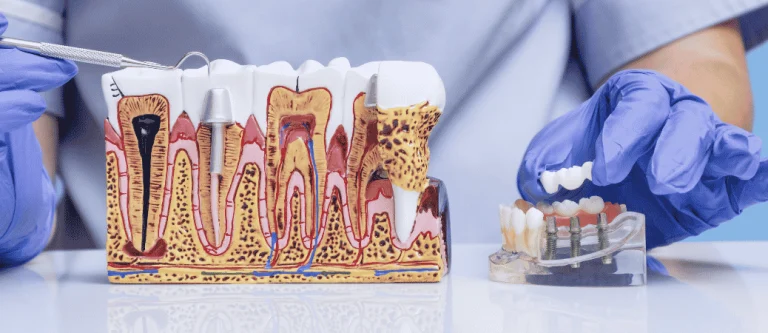
You can often replace a failing dental bridge with implants while keeping anchor teeth that remain healthy enough to restore.
Your supporting teeth need individual assessments because some may need separate crowns, while teeth with damage beyond repair may require extraction.
A loose or painful bridge deserves prompt attention, even if you are still able to chew. Decay beneath a crown sometimes stays hidden, and movement can put extra strain on the supporting teeth.
When considering dental implants, the starting point is understanding what remains beneath and around your old bridge.
Saving healthy teeth and assessing the available jawbone can help you avoid unnecessary treatment and plan a more suitable replacement.
What Happens to the Anchor Teeth?
Your anchor teeth, also called abutment teeth, are assessed individually for repair or removal.
Gum recession around your dental bridge exposes vulnerable root surfaces, but the condition of each tooth and its supporting bone determines your treatment.
When Healthy Anchor Teeth Can Be Saved and Crowned
You may keep a prepared anchor tooth when enough sound tooth structure and healthy support remain. After bridge removal, your dentist checks for decay, cracks, and signs of infection inside the tooth.
If you choose implants for the missing teeth, your former anchors may need dental crowns to restore their shape and protect the remaining tooth structure.
When Decay, Fractures, or Gum Disease Make Extraction Necessary
You need an extraction assessment when decay extends too far below the gum, a root has a serious fracture, or gum disease has destroyed too much support.
A tooth’s appearance above the gum gives only part of the picture.
Your dentist should explain why a tooth is considered beyond repair and whether a predictable saving treatment exists. Infection alone does not automatically mean extraction.
Some infected teeth can still be preserved with root canal treatment when enough healthy tooth structure and supporting bone remain.
Why Switching to Implants Does Not Restore Previously Removed Enamel
Your anchor teeth stay smaller after the bridge comes off because their original preparation permanently removed tooth structure. Switching to implants does not make that enamel grow back.
You still need protection for those prepared surfaces, even when they no longer support a bridge. Separate crowns restore their shape and help protect the remaining tooth structure during chewing.
Are Your Bone and Gums Ready for Implants?
Dental implant candidacy depends on the health of your gums, remaining teeth, and the amount of jawbone available to support the implant.
What a Professional Assessment and Dental Imaging Reveal
Your examination includes gum measurements, tooth stability checks, and an assessment of your bite. Dental X-rays help your dentist look for hidden decay, root problems, and bone loss around your abutment teeth.
For implant planning, your dentist may recommend a cone-beam CT scan to measure bone height and width and locate nearby nerves or sinuses.
Your jawbone density and bone shape also affect the surgical plan, although imaging cannot reveal every crack or hidden defect.
When Bone Loss Requires Grafting
You need enough bone in the planned implant position to support the implant safely. Under a long-standing gap, your jaw ridge sometimes becomes narrower or shorter after tooth loss.
If the available bone is insufficient, your plan may include bone grafting. A smaller graft sometimes accompanies implant placement, while a larger reconstruction may require a separate healing stage before surgery proceeds.
Ask what the graft is intended to achieve and how its healing will be checked. Your treatment schedule should allow for changes if the site needs more healing.
How Gum Disease, Smoking, and Medical History Affect Candidacy
Active gum disease should be brought under control before implant treatment. Periodontal therapy can help address gum inflammation and improve the foundation for future implant placement.
Tell your dentist about smoking, diabetes, past head or neck radiation, and every medication you take. Smoking and poorly controlled diabetes increase healing risks, while certain bone medications require additional planning.
Your medical history does not automatically rule out implants. Your dentist might coordinate with your physician, and you should keep taking prescribed medicines unless your treating clinicians advise a change.
Which Replacement Option Fits Your Remaining Teeth?
Your replacement should preserve useful teeth while giving you a stable bite that you can clean.
The health of your remaining anchors helps determine whether individual implants, an implant-supported bridge, or another restoration fits your needs.
| Your treatment consideration | Individual implants | Implant-supported bridge | Tooth-supported bridge | Removable partial denture |
| Your source of support | Jawbone | Jawbone | Anchor teeth | Gums and remaining teeth |
| Your need for implant surgery | Yes | Yes | No | No |
| Your replacement design | Separate crowns | Connected teeth | Connected teeth | Removable teeth |
| Your cleaning access | Between crowns | Beneath bridge | Beneath bridge | Remove for cleaning |
When Individual Implants Make Sense
You may choose individual dental implants when separate replacements fit the available space and bone. If your old bridge replaced a single missing tooth, a dental implant in that gap lets sound anchor teeth receive their own crowns.
Understanding how dental implants work can help you see how a single implant supports a replacement tooth without relying on the neighboring teeth.
Your dentist still needs to confirm safe spacing between the implant and neighboring roots, along with enough room for a natural-looking crown.
When an Implant-Supported Bridge Can Replace Several Teeth
You may replace a longer gap with an implant-supported bridge when the planned implants provide suitable support. Your design does not necessarily require an implant for every missing tooth.
The number and positions of implants depend on the span, your bone, and your chewing forces. With implant bridges, you also need enough cleaning space beneath the connected replacement teeth.
Your plan should identify which natural teeth will remain separate. Connecting a natural tooth and an implant within the same bridge requires special consideration because they move differently under pressure.
When Repair, a New Bridge, or a Partial Denture Is Reasonable
You have reasonable non-implant choices when your remaining teeth offer reliable support or surgery does not suit your needs.
A limited chip sometimes allows repair, while a new tooth-supported bridge requires dependable abutments and a healthy foundation.
If you want a removable option, a partial denture can replace several missing teeth. Ask how its clasps will affect appearance and which remaining teeth will carry the load.
Your bridge replacement discussion should include the likely repair burden of each option. Dental bridges remain useful when their design and supporting teeth suit your mouth.
How Does the Switch From Bridge to Implants Work?
Your transition follows a planned sequence of bridge removal, disease treatment, implant placement, and restoration.
You should receive a provisional plan before removal, with room for changes once your dentist sees the underlying teeth directly.
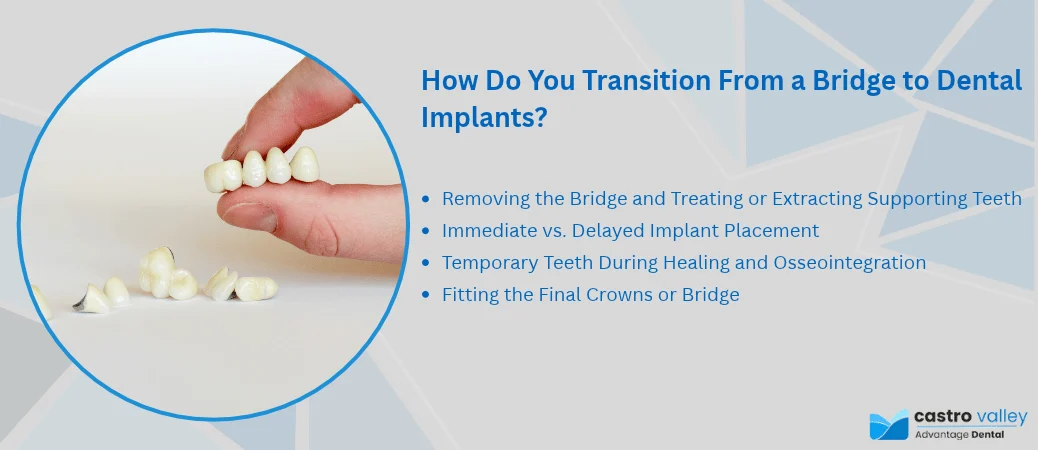
Removing the Bridge and Treating or Extracting Supporting Teeth
Your dentist removes the bridge carefully, sometimes by cutting it into sections. This approach gives access to the abutment teeth while limiting unnecessary force on weakened structures.
Once the bridge is off, your dentist checks the amount of usable tooth structure. Your next appointments address decay or root problems, and any teeth needing extraction are included in the surgical plan.
Before removal, ask how prepared teeth will be protected between visits. Also ask what happens if the findings change the original treatment estimate.
Immediate vs. Delayed Implant Placement
Immediate implant placement may be possible when the extraction site and surrounding bone allow secure implant positioning.
Your dentist also considers infection, gum health, and the ability to achieve sufficient initial implant stability.
With delayed placement, you allow the socket or graft to heal before surgery. Your dentist recommends this route when the site needs further treatment or a more developed bone foundation.
Same-day implant placement and same-day fixed teeth are separate decisions. Receiving an implant during extraction does not promise that you will leave with a tooth attached to it.
Temporary Teeth During Healing and Osseointegration
You may have a removable temporary tooth, a temporary bridge, or another short-term restoration during healing. Your options depend on the gap and whether a temporary would put pressure on the surgical site.
Your implant gains its bone connection through osseointegration. During this healing process, your dentist gives you eating and cleaning instructions to protect the area.
Discuss temporary teeth during implant treatment before your bridge is removed. Confirm their cost, appearance, and chewing limits, because a temporary replacement is not suitable in every situation.
Fitting the Final Crowns or Bridge
You receive your final implant restoration after your dentist confirms adequate healing and stability. Impressions or digital scans record the implant positions and the shape of your bite.
At fitting visits, your dentist checks contact with neighboring teeth and how your teeth meet during chewing. For implant-supported restorations, you also need a demonstration of how to clean around the crowns or beneath the bridge.
Ask how the restoration is attached and how future repairs would be handled. Keep a record of your implant system and restoration details.
What Are the Costs and Long-Term Trade-Offs?
Your total cost includes care for the old anchor teeth as well as the replacement teeth. Dental implants add surgery and healing, while a new dental bridge continues to rely on its natural supports.
What Changes the Total Treatment Cost?
You need an itemized estimate that covers the full treatment sequence. Ask whether it includes bridge removal, imaging, extractions, grafting, temporary teeth, implant components, and the final restoration.
Your saved anchor teeth also belong in that estimate. Separate crowns or root canal treatment add costs even when implants replace only the original missing teeth.
When weighing implant costs and long-term value, compare the complete treatment plans rather than the cost of the implant alone.
Request an itemized estimate so you understand the expected expenses and can discuss available payment options before treatment begins.
How Do Longevity and Future Repairs Compare?
Your implant and the crown attached to it have different repair needs. A sound implant might remain in place while its crown needs replacement because of wear or damage.
With a tooth-supported bridge, trouble in an anchor tooth sometimes affects the whole connected restoration. Your dental bridge’s lifespan depends partly on the health of those supports and your ability to keep the margins clean.
Neither treatment comes with a lifetime guarantee. Ask about likely repairs and whether the proposed design allows straightforward access if a component needs attention.
What Daily Cleaning and Follow-Up Help Prevent Complications?

Dental implants cannot develop cavities, but the surrounding tissues remain vulnerable to inflammation. When inflammation is accompanied by progressive loss of supporting bone, the condition is called peri-implantitis.
Use fluoride toothpaste for your natural teeth and clean beneath connected restorations. Your dental team should match your implant cleaning tools to the space, then watch you use them.
Regular preventive dental care allows your dentist to monitor your implants, remaining natural teeth, and surrounding gums. Your recommended visit schedule will depend on your individual risk factors.
Preserve Healthy Anchor Teeth and Plan Around What Remains
Replacing a failing dental bridge starts with identifying which supporting teeth can be saved and whether your jawbone can support dental implants.
A thorough assessment helps you understand whether implants, a new bridge, or another restoration offers the most suitable long-term solution.
At Castro Valley Advantage Dental, your bridge replacement plan takes the condition of your remaining teeth, jawbone health, and treatment goals into account.
Dr. Matthew Yuen can evaluate your existing bridge, explain which anchor teeth may be preserved, and discuss implant options based on your individual needs.
Before moving forward, ask for a clear treatment plan showing which teeth can be saved, whether grafting or extractions are necessary, and how your temporary and final restorations will be managed.
Frequently Asked Questions
Your questions about bridge replacement should lead to specific decisions about your teeth and treatment schedule. Use the answers below to prepare for your examination.
Can a loose dental bridge be removed and recemented instead?
You may have your bridge recemented if it is intact, fits correctly, and has sound supporting teeth.
Arrange an examination before using it for chewing; if it detaches, follow safe steps for a dental bridge that falls out and avoid household glue.
Do all the anchor teeth need to be extracted before implants?
You do not need every anchor tooth extracted to receive dental implants. Ask your dentist to explain the outlook for each abutment separately, including whether an individual crown would provide reliable protection.
Is replacing a dental bridge with implants painful?
You receive local anesthesia for implant surgery, and you should tell your dentist if you feel sharp pain during treatment.
Afterward, your soreness and swelling depend on the procedures performed, so request a pain-control plan and call if symptoms worsen or you develop fever.
Can I get implants if I have bone loss under my bridge?
You may still qualify for implants with bone loss if imaging shows a workable placement or grafting plan.
Ask whether a graft is needed, when the site will be reassessed, and which alternatives remain available if support is insufficient.
How many times can a dental bridge be replaced?
There is no fixed limit to how many times a dental bridge can be replaced. Each replacement depends on whether the supporting teeth have enough healthy structure and bone to support another restoration.