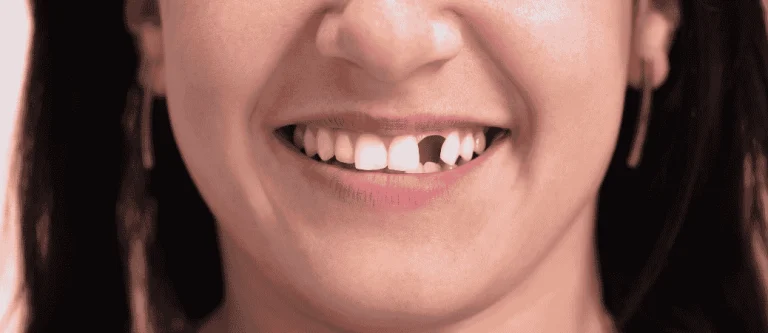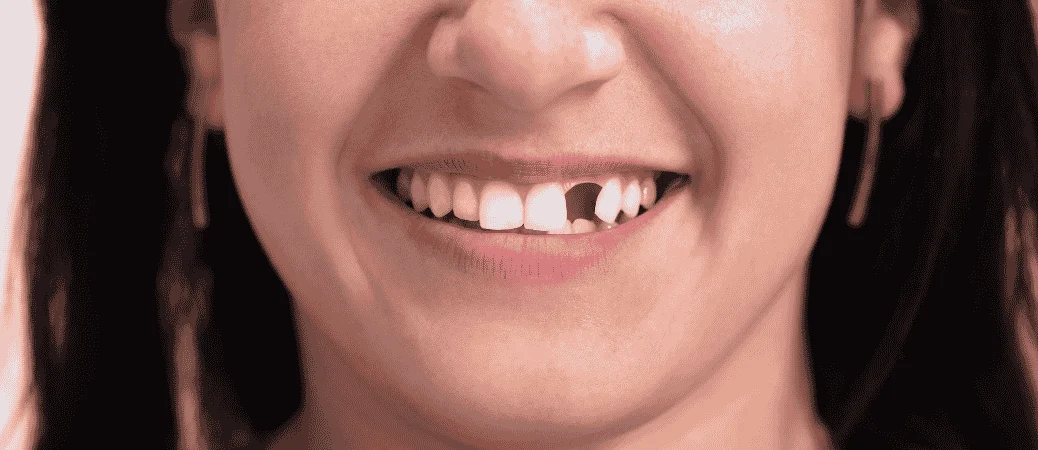
Losing a tooth rarely feels like an emergency once the soreness fades. The gap stops hurting, you learn to chew around it, and life keeps moving.
If your goal is to replace a missing tooth, an exam can show whether a dental implant, bridge, or partial denture fits your situation.
Here’s what tends to happen in the meantime. When a missing tooth goes unreplaced, the jawbone under the gap starts to shrink, the teeth beside it drift toward the open space, and your bite slowly changes, which can make future treatment more involved than it would have been early on.
None of these changes usually hurt, which is exactly why they go unnoticed.
The encouraging part is that a gap you’ve had for years is still worth talking about. An exam and X-rays can show what’s changed, and you may have more choices left than you expect.
Key Takeaways
- Bone shrinkage and tooth drifting begin within months of losing a tooth, often without any pain or obvious signs.
- An untreated gap can affect chewing comfort, cleaning, bite alignment, and the health of the teeth around it.
- Even long-standing gaps are frequently treatable, though bone grafting or straightening teeth may be added to the plan.
The Short Answer: Why Timing Matters
Timely tooth replacement keeps your options open. The sooner a gap is evaluated, the more likely a straightforward restoration will work without extra steps like rebuilding bone or moving drifted teeth back into place.
That said, timelines vary from person to person. Bone density, gum health, the position of the gap, and habits like smoking all influence how quickly things change.
Changes Can Begin Before You Notice Symptoms
Bone remodeling starts almost immediately after a tooth extraction. The ridge that once held the root begins to narrow and lose height, and the fastest loss happens in the first few months.
You won’t feel that happening. Most people only notice much later, when a denture stops fitting or an implant plan requires bone grafting first.
When a Missing Molar May Be Easier to Ignore
A missing molar sits out of sight, so there’s no cosmetic reason to rush. Molars also do the heaviest chewing work, which means the gap quietly changes how you eat.
Back-tooth gaps still affect bite balance and long-term oral health, as dentists who treat missing molars point out. The teeth on either side lose a neighbor to lean against, and drifting follows.
Why an Early Dental Evaluation Preserves Choices
An early exam gives your dentist a baseline: bone height, gum condition, and how the neighboring teeth are holding position. From there, a plan can be simple.
At Castro Valley Advantage Dental, that visit is a conversation about what you want to fix, what your budget allows, and how soon you’d like to start.
Dr. Matthew Yuen can review your X-rays, explain whether an implant, bridge, or partial denture makes sense, and help you understand the next step.
How an Untreated Gap Changes Your Mouth
An empty socket sets off a slow chain reaction: bone resorbs, nearby teeth tip and slide, the opposing tooth drops or rises into the space, and the resulting bite changes create new spots where food packs in.
Each change makes the next one easier.
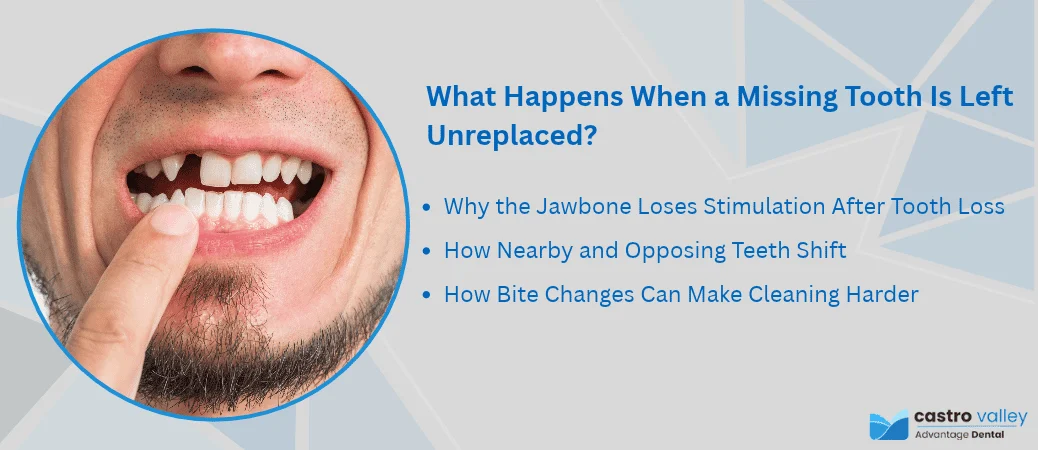
Why the Jawbone Loses Stimulation After Tooth Loss
Your tooth root presses into the jawbone every time you chew, and that pressure tells the bone to stay dense. Take the root away and the signal stops.
The body then breaks down bone it no longer needs, a process called bone resorption. Both the height and width of the ridge can shrink, and losing width is often the bigger obstacle for implants later.
How Nearby and Opposing Teeth Shift
Teeth hold each other in place. Once there’s an opening, the tooth in front and the tooth behind start tipping toward it, sometimes within weeks.
The tooth in the opposite jaw has nothing to bite against, so it can drift down (or up) out of its socket. That creates crowding on one side, spacing on the other, and a bite that no longer meets evenly.
How Bite Changes Can Make Cleaning Harder
Tipped teeth create tight, angled spaces that floss struggles to reach. Food particles collect there and stay.
That’s how a simple gap turns into cavities and tooth decay on the teeth beside it, plus inflamed gums that can progress to periodontal disease.
Since gum disease and whole-body health are connected, an untreated pocket next to a gap deserves attention.
Effects on Chewing, Speech, and Comfort
The daily effects show up gradually: you favor one side when you eat, certain sounds change slightly, and your jaw muscles work harder to compensate.
Some people also notice their face looks a little different where bone has receded.

Why Chewing Can Become Uneven and Less Efficient
Each tooth carries a share of the biting load. Remove one and the rest absorb more pressure, so chewing efficiency drops.
Most people adapt by shifting to the stronger side. That habit puts extra wear on those teeth and their muscles, and steak, raw vegetables, and nuts become the foods you avoid without deciding to.
When a Missing Tooth Affects Speech
Front and side teeth guide airflow when you talk. A gap there changes how air moves, which shows up most in “s,” “f,” and “th” sounds, sometimes as a slight lisp.
Speech changes from a single back tooth are uncommon. Gaps closer to the front are the ones that alter pronunciation.
Jaw Strain, Tooth Wear, and TMJ Symptoms
When your bite meets unevenly, the temporomandibular joint and the muscles around it take up the difference. That can mean jaw discomfort, morning tightness, or headaches for some patients.
Uneven contact also grinds down enamel in specific spots. If your bite already feels off, learning how bite issues can be corrected helps you ask better questions at your next visit.
Bone loss under the gap can also make the cheek or lip area look slightly sunken, and facial sagging around a long-standing gap affects how some people feel about their smile.
Which Tooth Replacement Option May Fit Your Situation?
Three main paths exist: a dental implant, a dental bridge, or a removable partial denture. Bone volume, the health of the teeth beside the gap, and your budget usually decide which one fits.
| Dental implant | Dental bridge | Partial denture | |
| Preserves jawbone at the gap | Yes | No | No |
| Alters neighboring teeth | No | Yes (crowned) | No |
| Removable | No | No | Yes |
| Typical treatment time | Several months | 2 to 3 weeks | 2 to 4 weeks |
| Relative cost | Highest | Middle | Lowest |
A partial denture averages $1,738 to $2,229 and a Maryland bridge about $1,569, making those the least expensive long-term choices in a 2026 cost comparison.
Dental Implants and the Role of Bone Volume
An implant is a titanium post placed in the jawbone, topped with an implant crown. Because the post replaces the root, it keeps stimulating bone the way a natural tooth did.
Implants need enough bone height and width to anchor safely. When bone has thinned, bone grafting can rebuild the site first, adding a healing stage before placement.
Reviewing how dental implants work makes that timeline easier to picture.
When a Dental Bridge or Partial Denture May Help
A dental bridge fills the gap using crowns on the two neighboring teeth. It works well when those teeth already need crowns and when you’d prefer to skip surgery.
Knowing what happens at a bridge appointment removes a lot of the unknown.
Removable partial dentures clip onto existing teeth and come out for cleaning. They’re the most affordable route and can replace several teeth at once.
For extensive loss, full dentures or implant-supported dentures come into the discussion.
What If You Have Waited for Years?
Long-standing gaps are still treatable in most cases. The plan may include bone grafts, or short-term orthodontic treatment to upright teeth that have tipped into the space.
Cost and fear both keep people away, and both have practical answers.
The team can review available payment options, including financing options listed by the practice, and help you understand the plan before treatment begins.
If dental anxiety is the real barrier, say so at the start so your visit can move at a pace that feels manageable.
Protecting Your Future Smile Starts With an Evaluation

Waiting doesn’t close the door, but it does change what’s behind it. Bone shrinks, teeth drift, and the bite adjusts, so a plan that would have taken one appointment may take three.
The next manageable step is an exam with X-rays to see where things stand. That visit tells you whether an implant, bridge, or partial denture fits, whether grafting belongs in the plan, and what the cost looks like month to month.
If a gap has been on your mind, bring it up. The team at Castro Valley Advantage Dental can walk you through the benefits of regular dental visits and build a timeline that works with your schedule and budget.
Frequently Asked Questions
How long can you go without replacing a missing tooth?
There’s no fixed deadline, though the most rapid bone shrinkage happens in the first three to six months after tooth loss. Replacing the tooth within the first year keeps the most tooth replacement options on the table.
Is it okay not to replace a missing tooth?
You can live with a gap, and some people do for decades. Doing so raises the risk of bone loss, drifting teeth, decay on the neighboring teeth, and gum problems, so a dentist should at least monitor the site.
When is it too late to replace a tooth?
It’s rarely too late. Even after years, a dental implant is often possible once bone grafting rebuilds the site, and bridges or partial dentures work in many situations where an implant doesn’t.
How can I cover a missing tooth while waiting for an implant?
A temporary flipper or a short-term partial denture fills the space during healing. Both are removable, inexpensive, and meant to hold appearance and function until the permanent restoration is ready.
Will I need a bone graft if I have waited years for a dental implant?
Sometimes, though not always. An X-ray or 3D scan measures the remaining bone height and width, and if the ridge has thinned past what an implant needs, grafting is added before placement.
Castro Valley Advantage Dental reviews those images with you before anything is scheduled.